Consultancy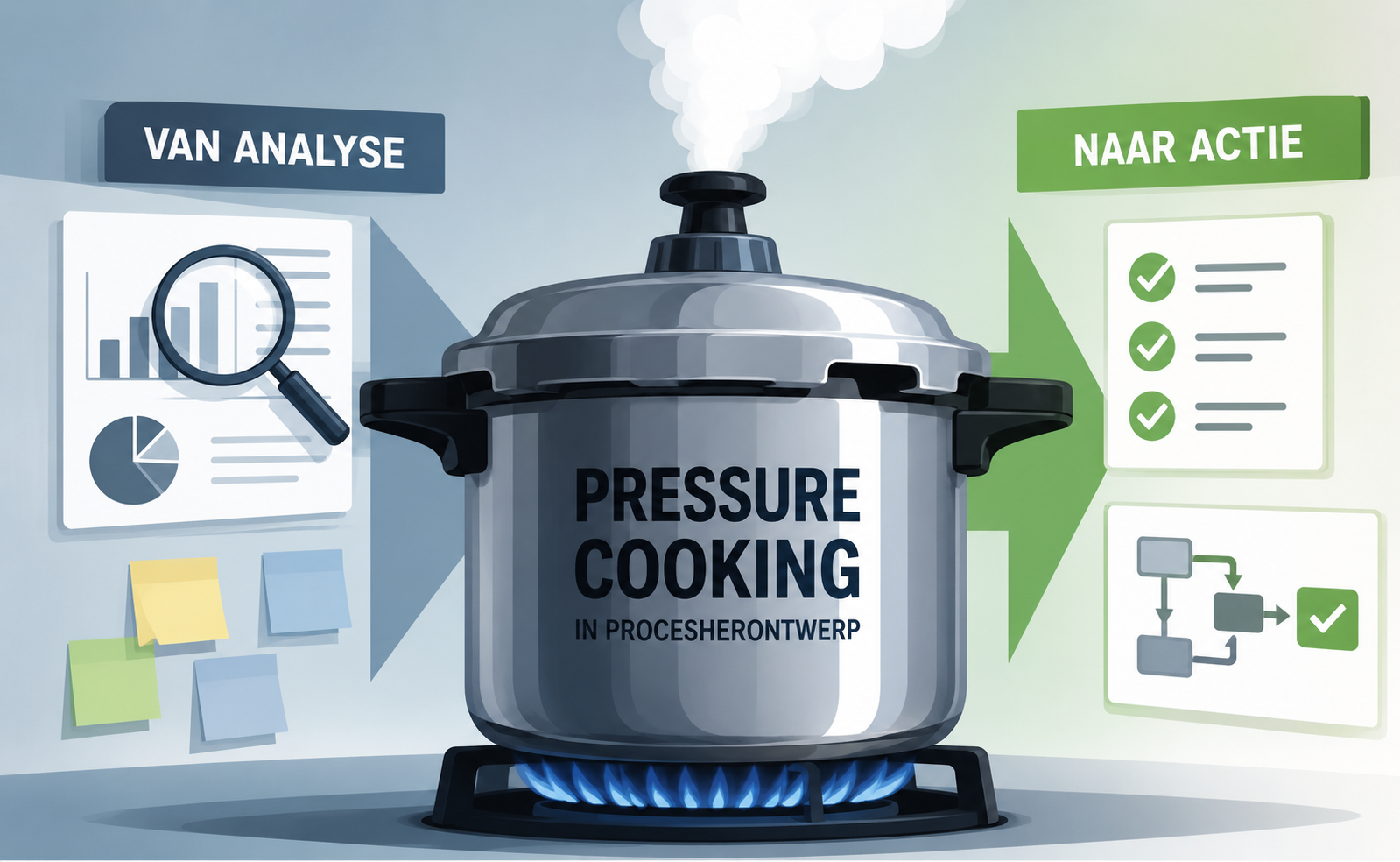
 Sneller Van Analyse Naar Actie De Kracht Van Pressure Cooking In Procesherontwerp
Many organisations want to improve their processes but struggle with how to approach this. Traditional programmes tend to follow a waterfall method, with sequential steps spread over several months. The result is long lead times, diminishing energy and limited scope for adjustment along the way. Drawing on their experience with various clients, Jesse van der Huizen and Nathan van der Meulen of BPM Consult show how organisations can begin implementing the first improvements almost immediately within process redesign initiatives.
A standard process redesign programme typically includes the following phases: preparation, mapping the current situation, analysing that situation, designing the desired future state and then implementation.
In practice, however, such programmes often take longer than initially planned. The causes broadly fall into three categories: avoiding disruption to business as usual, traditional project thinking, and a loss of energy among employees.
Avoid disrupting day-to-day operations
Management wants to avoid disrupting day-to-day operations, and therefore allocates only limited time for employees. At the same time, organisations often find it difficult to make choices, resulting in many initiatives being undertaken in parallel.
The same employees are frequently involved in several of these initiatives, causing them to move from one improvement project to another. In addition, there is a misconception that spreading activities over a longer period is cheaper and leads to better quality. We take the opposite view: the best results are achieved under focused pressure, with clear direction and pace.
Traditional project thinking
Organisations often become stuck in a sequential approach: first mapping the current situation, then analysing it, followed by designing the future state, and only then moving to implementation. As a result, lead times increase because improvements cannot begin until the analysis is complete.
In practice, we see that longer timelines can lead to a loss of focus, declining engagement and a fading sense of urgency, ultimately weakening the final outcome.
Human energy drain
Experience shows that spreading activities over a longer period ultimately leads to lower motivation among employees. Because there is often a significant gap between sessions, people have to re-immerse themselves in the content each time, which takes effort and can be frustrating.
In addition, change readiness declines in programmes that drag on, as the sense of progress or success is missing and results take too long to materialise. This reduces the urgency of the initiative and makes it harder to maintain engagement and decisiveness.
We also see organisations striving for perfection and waiting until every analysis has been fully completed. This leads to analysis paralysis and stagnation.
The alternative: a springboard through pressure cooking
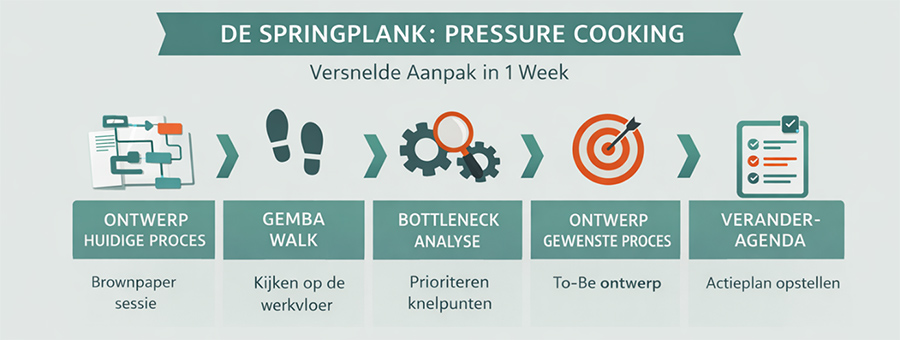
Because the underlying causes are mainly fragmentation and a lack of focus, a short-cycle approach is more effective. We therefore propose pressure cooking: a compact, intensive week in which the most important elements of analysis and design are combined.
This forms the springboard for the programme: a flying start that immediately sets the direction for implementation. The springboard is a short, focused preliminary phase of one to two weeks in which teams:
- Map the current processes, including a process walk known as a Gemba walk
- Identify bottlenecks and areas for improvement
- Design the desired future processes
- Draw up the change agenda
During the pressure cooking phase, we operate an open-door policy. In addition to management, process owners, key users and employees involved in the sessions, the door is open to other interested colleagues. This is actively encouraged in order to engage a broader group.
The result is a clear starting point from which improvement can begin. There is a sense of urgency, energy levels are high and teams experience tangible progress within days.
How does ‘pressure cooking’ work in practice?
Preparation
In the preparation phase, we define the objective and the ‘why’ of the project. We also develop the business process model and prioritise the processes to be addressed, as not everything can be tackled within a short timeframe. We organise a kick-off with process owners and key users to introduce the topic.
Design the current processes
During the pressure cooking week, we carry out the following activities in one week together with experts from the organisation:
- Together with key users, we map the current process using the brown paper method. The output of this step is a process design capturing the process steps, applications, data flows and bottlenecks.
- Through a Gemba walk, we validate the process on the shop floor. This allows us to speak with other stakeholders and experience first-hand how the process actually runs in practice, ensuring it stays closely aligned with reality.
- We then carry out a bottleneck analysis. Back in the meeting room, we review the identified bottlenecks and jointly determine where the greatest improvement potential lies within the process. The output is a prioritised list of issues to address, which provides direct input for the implementation phase.
Design the desired future processes
Based on the insights from the current process, the Gemba walk and the bottleneck analysis, we jointly design the desired process. This process design guides the implementation phase and provides clear direction for prioritising and planning improvements.
Change agenda
Finally, based on the analyses above, the change agenda can be drawn up. This provides insight into which elements of the process need improvement and in what order.
These steps are followed for each process. The analyses form the starting point for initiating improvements and implementation. The overall outcome is therefore an analysis of your organisation’s performance, combined with a design of the desired future state and a clear set of elements to be improved.
The result: Speed, focus and impact
Thanks to the pressure cooking week, pace and clarity are created in the process redesign programme. This enables you to achieve tangible results in a short period:
- Analysis and redesign: In a single phase, the current situation is analysed and translated into a redesigned process, without being fragmented across multiple weeks or sessions.
- Direction for implementation: Decisions are made during the week itself, creating a clear direction for the implementation phase.
- Engagement and motivation: collaboration fosters a sense of ownership among subject-matter experts, and the pressure has a motivating effect.
- Ability to adjust quickly: because design and validation take place in close succession, assumptions and decisions can be tested and refined.
- A kickstart to change: the pressure cooking week acts as a catalyst, setting the transformation in motion.
A key prerequisite for success is leadership that recognises the urgency, is actively involved, demonstrates commitment by freeing up staff, and is open to new ways of working. This is essential to maintain focus.
Conclusion
A process redesign programme truly comes to life during a pressure cooking week. The results of a week of intensive collaboration are immediately visible: energy levels within the team are high and momentum is created for the next steps.
By combining analysis, design and decision-making within this period, a springboard for implementation is created. This significantly enhances both the pace and the quality of the overall process redesign programme.