Consultancy
 Rits Je Klant Aan Het Interne Proces Het Verbinden Van De Klantreis Aan Werkproces
A standard customer satisfaction survey generally offers limited guidance in truly understanding the customer’s needs and expectations. While such a survey provides the customer with an opportunity to express their opinion about your organisation’s product or service, it only gives a broad indication of their expectations and level of satisfaction. Mapping the customer journey, however, provides genuine insight into the customer’s needs and expectations.
Statement: “The service delivery was adequate.”
Answer: “Largely agree”
It is difficult to take concrete action to improve your organisation based on such statements and responses. Response rates have also generally been declining, as people are increasingly experiencing survey fatigue.
In recent years, organisations have been moving away from traditional customer satisfaction surveys, and the customer journey has gained prominence. By mapping the entire customer journey with a small focus group, it becomes much clearer where opportunities lie to enhance the customer experience. Much has already been written about customer thinking, for instance The Customer Delight Strategy (2012) and Service Excellence (2016). However, it is often difficult to determine exactly how a customer journey connects with an organisation’s internal processes. And it is precisely this connection that is essential for effectively improving service delivery.
The key is to design your organisation’s way of working so that it truly supports the customer journey. By seamlessly linking the customer journey to concrete activities within internal processes, you gain insight into which levers to adjust in order to improve the customer experience. For most organisations, processes are primarily focused on what happens within the walls of the organisation, viewed from the perspective of the traditional quality staff function, rather than on interactions with and alignment to the customer. Based on experience across various service organisations, we have developed an approach to redesign processes with a focus on customer experience.
Starting point: working from a solid internal foundation
To concretely improve the customer’s experience journey, you need to establish a direct link with your organisation’s way of working. This requires that your internal processes are first put in order. Without a ‘healthy’ internal process as a solid foundation, meaning error-free and without waste, it is impossible from the outset to satisfy the customer.
In the service pyramid described by Thomassen and De Haan (2016, see Figure 1), this relates to the bottom two levels. A product or service must meet customers’ basic expectations at level one, the value proposition, such as timeliness, a reasonable price and quality. In addition, the organisation must handle complaints exceptionally well at level two.
Once processes run efficiently, are properly embedded and complaints are handled excellently, the foundation is in place. You can then focus on the third and possibly the fourth level: offering tailored solutions to the customer and ultimately surprising and delighting them with an optimal experience. At levels three and four, directly linking the customer journey to the process helps to embed strong, customer-focused service into all processes within your organisation.
Modelling the customer journey
To give more substance to the modelling of the customer journey, we outline four core elements of a customer journey that directly connect to the organisation’s processes:
- experience phases
- customer activities
- tangible evidence
- customer emotion
The result of mapping these four elements is an enhancement of the ‘standard’ functional flowchart (swimlane), ensuring that the customer is given a prominent place in every process and that each activity within the organisation can be geared towards optimising the customer experience.
Core element 1: Experience phases
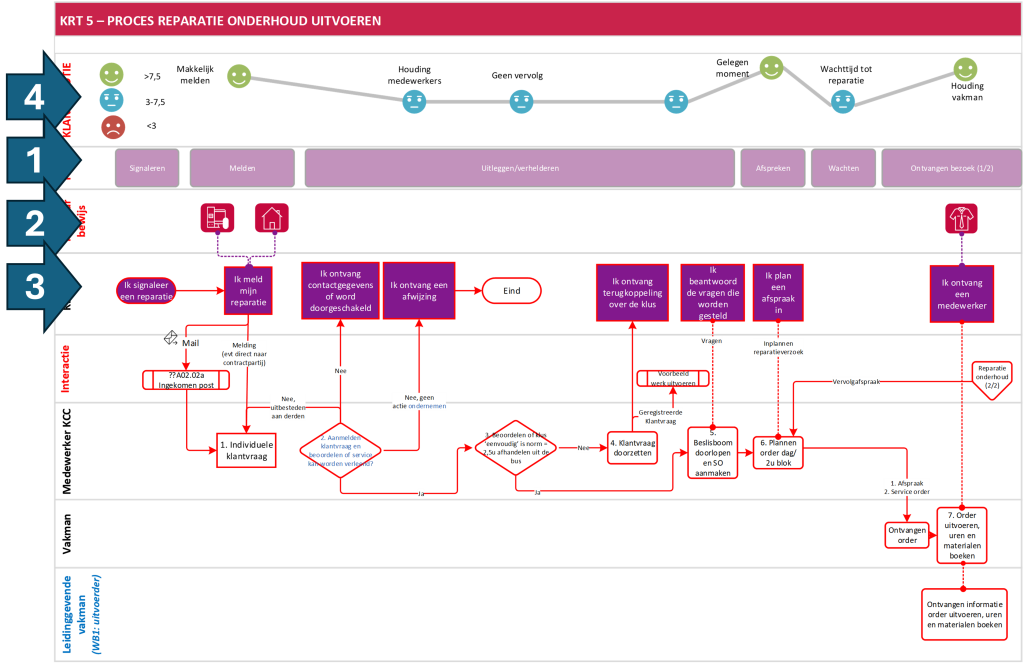
The starting point for modelling the customer journey within the enterprise architecture process is the experience phases (see Figure 2). These are the main steps that the customer goes through during their journey. Try to express these experience phases in a single verb, such as exploring, ordering, waiting, receiving or using. This perspective clearly highlights the contrast between the customer’s experience and the internal process.
The customer’s journey often begins even before the first contact with the organisation, something organisations typically pay too little attention to. It also immediately becomes clear that a large part of the internal organisational process is simply perceived by the customer as ‘waiting time’, which tends to accumulate. Making this waiting time visible in the process design is already valuable, as it helps employees realise that the customer experiences the journey very differently from how the organisation’s internal process is structured. Customers generally have little interest in how an organisation is organised internally.
Core element 2: Customer activities
After mapping the experience phases, the customer activities can be identified (see Figure 3). Together with the customer, describe their activities in a narrative, first-person form. This makes it easier for employees to empathise with the customer’s world. After all, what provides a better basis for empathy: “Placing an order via the website” or “I go to the website, I look for the products I want to order, and I place my order”?
The customer is then given their own swimlane in the process design. This swimlane is positioned at the top of the design and effectively stitches the customer’s world onto the internal process. The interactions between the customer and the organisation connect these two worlds. These interactions can take place through various channels, such as sending a letter or email, but also through more direct forms of contact like a phone call or speaking to someone at a desk. By mapping these communication channels, you can assess whether they are the most suitable option for the customer.
Core element 3: Tangible evidence
For “tangible evidence”, the customer is asked what they actually see of the organisation during the journey they go through (see Figure 4). This goes beyond just the organisation’s logo or the product the customer purchases. It concerns all the physical expressions that the customer associates with your organisation. Websites, letters, emails, uniforms and waiting areas all reflect the organisation’s identity. Together, these expressions form a significant part of the image customers have of your organisation.
With the idea that a first impression may be decisive, you can consider what the first interaction with your organisation should look like. A car park without clear signage to the entrance creates a negative experience, just as encountering a poorly presented employee does. In short, mapping tangible evidence provides greater insight into what the customer sees and feels about your organisation and offers clear opportunities for improvement.
Core element 4: Customer emotion
Once the experience phases, customer activities and tangible evidence have been mapped, you can more deliberately explore the customer’s emotions at different moments throughout their journey (see Figure 5). To do this, you invite the customer to answer specific, qualitative questions about their perception of the service. The result is the customer’s ‘emotional rollercoaster’.
If the customer is present, you can immediately probe further into why they feel dissatisfied or, on the contrary, satisfied at particular moments, and which contact points were most significant, the so‑called ‘moments of truth’. This can provide valuable insights for concrete improvement actions. Employees can also, based on their own experience, estimate the emotions customers may experience at different stages.
Interpreting the customer journey
Now that the internal and customer processes have been mapped together, you can begin interpreting the customer journey. Start by walking through the entire process from beginning to end (see Figure 6). Assess whether the interaction points between the customer and the organisation are logical, efficient, effective and appropriate. Identify any gaps and mismatches between the internal process and the customer’s process. Where do you see points of customer engagement and disengagement? Where is the customer dissatisfied, can this be prevented, and what changes are needed to achieve that?
Make sure to record your observations clearly, linked to specific points in the process, so that you can take targeted action later. Also clearly describe the negative impact of each observation. If the impact is relatively minor, there are often other improvement opportunities that will yield greater benefits. Finally, also describe the proposed future state. What would the situation look like if it exceeded the customer’s expectations? Experience shows that linking the customer journey to internal processes directly supports the generation of effective solutions. When interpreting the customer journey, ensure that the right disciplines are involved, people who understand which levers can realistically be adjusted.
Challenges in linking the customer journey to the internal process
The approach described here also comes with a number of challenges. As mentioned, organisations are not typically set up to explicitly incorporate the customer journey into their way of working. Many employees still find it quite daunting to invite a customer and discuss their own working methods face to face. It is therefore quite a challenge for them to shift to customer-oriented thinking and move beyond the internal process.
Attitude and behaviour form a second challenge. Many employees are inclined to stereotype customers, and this can be counterproductive. For example, sending a letter while already ‘knowing’ in advance that it will not be read by ‘that kind’ of customer. Or assuming that if you offer two options, the customer will always choose the non-existent third option. These kinds of perceptions about customers are very common, but they can hinder the transition towards aligning with the customer journey and experience.
A third challenge is having the courage and ability to think outside the box. It requires letting go of all existing written and unwritten rules, truly putting yourself in the customer’s shoes, and daring to take a new direction. If this proves difficult, consider organising a small innovation contest, where the person with the best or most groundbreaking idea wins a prize.
Finally: implementing improvements
To actually improve the customer journey, concrete improvements need to be implemented. Interpreting the customer journey will likely have produced a long list of bottlenecks, which together represent significant improvement potential.
Ideally, these improvements are further developed by the operational teams themselves, as they know the details of their work better than anyone. It is important, however, that they are given sufficient time, resources and autonomy to carry out the changes effectively.
If the list of suggested improvements is too long, it is essential to prioritise properly, for instance by using an impact–effort matrix, comparing the effort required with the expected benefits. This results in a more manageable set of improvement actions.
The final step is simply to take action and implement these improvements, all aimed at achieving a consistent and continuously improving level of service, day after day.