Consultancy
 5 Valkuilen Bij Het Uitvoeren Van De Gebruikersacceptatietest
In software development, user acceptance, known as the user acceptance test (UAT), is of great importance. After all, these are the people who will ultimately use the software in their day-to-day work and therefore form the foundation of a successful software implementation.
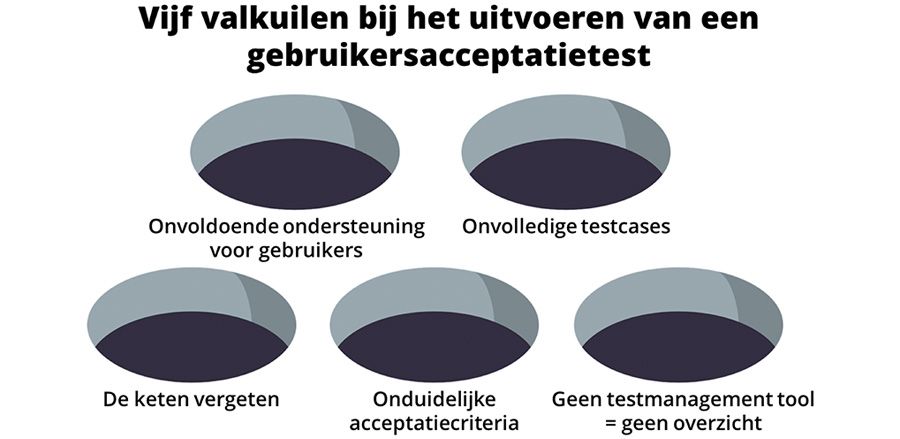
To avoid falling flat during the user acceptance test, a well-thought-out approach is required. But how do you design this effectively? And which acceptance criteria are important? Pieter van de Vliert of BPM Consult shares tips for a successful approach, based on five common pitfalls.
1. Inadequate support
If testing users do not have sufficient knowledge of the software, this reduces both the speed and the quality of the testing. Users spend their time figuring out how the software works: they cannot find the buttons and lack an overview. This valuable time is then lost, taking away from the actual testing.
Ensure that testing users have sufficient knowledge before each test. Provide demonstrations of the functionalities to be tested so that users become familiar with the software. A short demo or spending two hours working through the system together with a software consultant is far more effective than spending eight hours trying to find the right button on their own. A Scrum development approach already facilitates this, as a sprint demo is delivered during every sprint.
2. Incomplete test cases
It is important during the UAT to test all key functionalities thoroughly. This requires specific test cases that together provide as complete coverage of the functionalities as possible.
A common pitfall when creating test cases is overlooking a particular functionality. Test cases may also be formulated too vaguely, making it unclear during testing which scenarios and details should be covered. As a result, the test does not achieve its purpose, namely validating the end-to-end business flow.
The following factors will help you create usable, complete and specific test cases in time:
- Work out each logical test case into a detailed, step-by-step physical test case. For example: “click on iDEAL under the payment methods section”.
- Ensure you have a complete set of functional and non-functional requirements that fully cover the functionalities. If requirements are described in a SMART way, test results become clearer and easier to assess.
- Build on this by translating each requirement into one or more logical test cases. An example of a logical test case is: order a product and pay using iDEAL.
3. Overlooking the end-to-end chain
If the system supports each individual business process, this does not automatically mean that it supports the flow across all processes. To return to the ordering example: the ordering process and inventory management may each function perfectly on their own, but without the exchange of data between them, placed orders will not be communicated to inventory management. It may also be unclear who is responsible at different stages of the process.
A chain test is an excellent way to address this. A chain test is a test in which multiple business processes are executed in a continuous sequence across platforms or systems. In addition to its IT-related purpose, a chain test also aims to identify any process-related issues that may arise. Especially in complex software solutions, a chain test is indispensable.
The chain test is the moment of truth for the entire UAT: it verifies whether the workflows are properly supported by the system. So do not skip the chain test.
4. Unclear acceptance criteria
Unclear acceptance criteria can lead to confusion and misunderstanding. For example, a project manager may underestimate the impact of critical issues, while an end user during the UAT may insist that even minor cosmetic issues must be resolved. It is therefore crucial that all stakeholders share the same understanding of the acceptance criteria in advance.
In general, there are three key guidelines for UAT acceptance criteria:
- All test cases have been successfully completed
- No critical issues remain open, and there is a clear definition of what constitutes “critical”
- It is clear who the key stakeholders are, and they all formally give their approval
Communicate these three acceptance criteria from the very start of the UAT. Make them visible and share them with all stakeholders. This helps prevent misunderstandings and reduces the risk of delays.
5. No test management tool means no overview
Without real-time insight into test cases and issues, it is difficult to steer progress effectively. Separate lists of test cases stored in different locations are a recipe for confusion, duplicated work, and gaps in testing. It can also make the go or no-go decision more difficult, as it becomes hard to demonstrate that all required test cases have been completed.
A test management tool such as TestFLO or TestRail is therefore essential, especially when combined with a tool for tracking reported issues, such as HubSpot or Jira. Using such tools offers a range of advantages:
- These tools make it easy to record test results in a structured way and to assign test cases or issues to individuals
- They enable project managers to closely monitor progress using dashboards
- They provide transparency and consistency, allowing everyone to follow, review and, if necessary, take over each other’s work
- Finally, a test management tool is indispensable from a compliance and audit perspective
Conclusion
User acceptance is the indispensable culmination of a software implementation. Precisely for this reason, it is important to get it right. Avoid the pitfalls mentioned and ensure that users in the testing process have sufficient system knowledge, enabling the testing to be carried out more effectively and efficiently.
Make sure that requirements are complete and clearly defined, and translate these into a comprehensive set of logical and step-by-step test cases. Do not forget to validate in a chain test whether the system supports all business processes. Communicate clear acceptance criteria before the start of the UAT so that there is a well-defined end point and confusion is avoided. Finally, make use of a test management tool to enable precise monitoring and control of progress.