Consultancy
 Continu Verbeteren Waarom Lukt Het Niet
In many organisations that aim to implement continuous improvement, the expected results often fail to materialise. According to Jesse van der Huizen, this is often because they approach continuous improvement too much as a rigid method: “A sustainable culture of improvement does not emerge by rolling out a single fixed approach, but by creating space for learning, iteration and feedback.”
Continuous improvement is similar to a football match. As a team, you create a clear game plan in advance: how you apply pressure, how you build up play and what your objective is. These are the guiding principles that provide direction.
However, once the match starts, it becomes clear that no plan holds up exactly as intended. The teams that succeed combine clear principles with the freedom to make the right decisions in the moment, precisely the balance that a continuous improvement approach requires.
In many organisations, we see that this balance has not yet been achieved. A crucial element is often skipped or simply fails to take hold. This concerns the continuous cycle of learning, adjusting and iterating. Yet this iterative process is the very core of any well-functioning continuous improvement structure.
As a result, the visibility of improvement increases. There are meetings, templates and routines. But the actual impact falls short. Improvement teams are carrying out activities, but true ownership of improvement, the ability to reflect, and the necessary iterations to genuinely learn and improve do not take off.
This leads to a culture of improvement that looks good on the surface, but where the engine of continuous learning, repeating, adjusting and trying again does not truly get going.
What these organisations need is a continuous improvement approach that fully takes into account their context and stage of maturity. Not a single prescribed route, but a way of working that encourages experimentation, learning and adjustment. This creates space for engagement and progress, without the structure getting in the way of momentum.
What holds continuous improvement back
A combination of factors often slows progress towards a genuine culture of continuous improvement. It is rarely about unwillingness or a lack of structure. Rather, it is about how improvement is shaped and experienced in everyday practice. The following causes are most commonly observed:
Every organisation is unique, with its own culture
An improvement blueprint assumes a single fixed approach, yet no two organisations are the same. What works exceptionally well in one organisation may not suit another at all. Consider differences in people, ways of working and strategic objectives.
“You cannot transform an improvement culture with a step-by-step plan alone.”
When this diversity is ignored, friction quickly arises in execution. The maturity of the organisation determines which improvement approach will or will not work in practice.
Team maturity
Teams differ greatly in their level of autonomy. Some employees are able to take ownership of improvements relatively easily and quickly find their way in new ways of working. Others need more support, for example in the form of clear frameworks and guidance simply to get moving.
If these differences are not recognised or reflected in the approach, there is a risk that part of the organisation will disengage or become stuck, while others are able to move forward.
An improvement culture cannot be imposed
An improvement culture is about how people think and act. That cannot be changed with a step-by-step plan alone. People need to want it themselves and believe in it, otherwise it remains no more than fine words on paper. Without intrinsic motivation, continuous improvement remains a paper exercise.
Continuous improvement requires ownership
When an approach is imposed from the top and everything is predetermined in a blueprint, teams often feel excluded. There is little room to contribute ideas or exert influence. Yet it is precisely this involvement and sense of ownership, taking responsibility for identifying and implementing improvements, that drives engagement and motivation, and ultimately leads to real, lasting change.
Flexibility is essential, improvement is a learning process
Continuous improvement means getting a little better each time. It does not always go right on the first attempt. You learn by trying things out, seeing what works, and adapting what does not. A fixed blueprint assumes there is only one right way, but in practice, progress comes from experimentation. Without flexibility, learning stops and development grinds to a halt.
Improvement as a habit
Improvement is not a system you can simply roll out, but a way of working that must come to life within teams themselves. It requires an approach that aligns with the organisation, with the people doing the work, and with what they need to get moving.
Just like a well-designed game plan, improvement only truly works when clear agreements are combined with the freedom to act in the moment. To achieve this, two principles are needed:
- Clear frameworks and direction, so that everyone understands the purpose of improvement and why we want to make things better.
- Room for teams, so that within those frameworks they can learn, experiment and take ownership.
Instead of choosing a single, uniform blueprint, you opt for guided customisation. The intent and ground rules are the same, but with the freedom to adapt the approach to the context of each team. In this way, a culture emerges in which iteration and feedback are the norm, and improvement becomes part of everyday work.
The five steps for effective guided customisation
When you want to help an organisation improve in a structured way, a clear and practical approach works best. A sustainable culture of improvement emerges when improvement becomes a natural part of everyday work. Not by imposing a rigid system from the top down, but by providing clear frameworks while at the same time giving teams the space to learn, explore and take responsibility themselves.
“The essence of an effective improvement culture is simple: improvement as a habit.”
The five steps below form a logical and practical process that takes into account both the organisation and the people who work within it.
1: Understand who to involve and how
Before you begin, it is important to understand how the organisation operates and who you need for what. This means looking at the culture, ways of working and the level of autonomy within teams.
By analysing this properly, you gain a clearer understanding of what is needed for the improvement process to succeed. Every organisation functions differently, and these differences are made explicit in this first step.
2: Establish an initial improvement structure
Based on your analysis, you design an initial structure for continuous improvement. You work from clear frameworks and direction, ensuring the process is not left to chance.
The starting point is always the underlying need: why improvement is necessary and what it will deliver. By connecting this need to the insights from step 1, you create a structure that fits the organisation and provides guidance for everyone involved.
3: Start the first improvement cycle
You then begin the first cycle. Together with the improvement team, you go through the fixed steps: prioritising, analysing, improving, embedding, celebrating success and monitoring organisational processes. This creates rhythm and clarity, and ensures that learning and improvement take place in small, manageable steps.
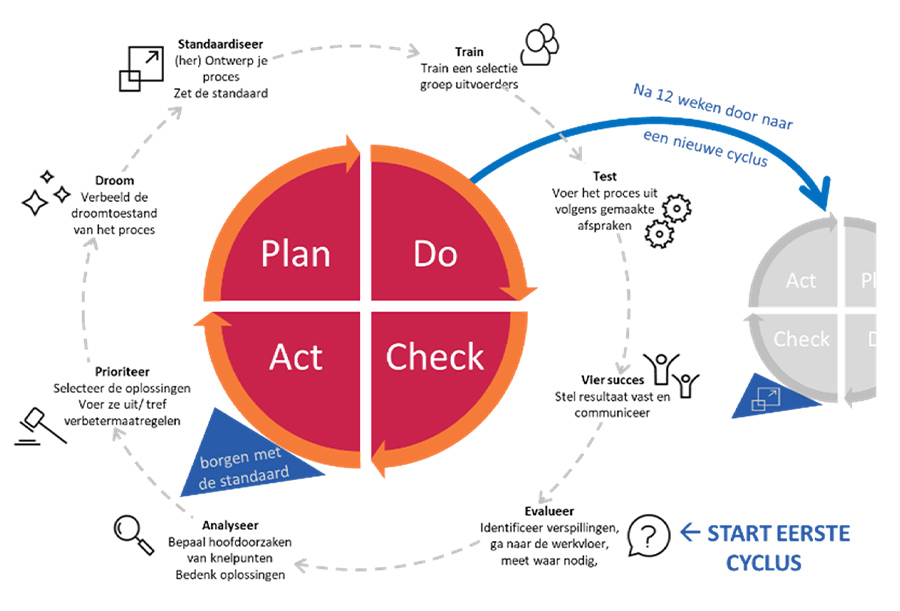
In this way, teams experience first-hand what the approach delivers. A clear division of roles between the process owner, key user, improvement coach and improvement team provides focus and support. Tools such as A3 plans help to keep the process clear and practical without taking ownership away from the teams.
4: Reflect after completing the improvement cycle
After the cycle comes a crucial step: reflection. You actively gather feedback from the improvement team and other stakeholders. What went well? What was less smooth? What challenges did people encounter? This reflection is not an afterthought, but an important moment to learn and determine what is needed to make the next cycle more effective.
5: Incorporate the insights into your improvement structure
Finally, you incorporate all the insights from the reflection into the improvement structure. You assess which actions are genuinely needed to strengthen the approach. Sometimes this means teams need additional support when their level of autonomy turns out to be lower than expected.
In other situations, you might involve the improvement team later in the cycle, for example only after improvements have been prioritised. The objective always remains the same: to ensure the team can work in a way that matches their level, pace and needs.
Conclusion
The essence of an effective improvement culture is simple: improvement as a habit. A sustainable improvement culture does not emerge by rolling out a single fixed approach, but by creating space for learning, iteration and feedback. Because every organisation and every team is different, continuous improvement requires clear frameworks that provide direction, combined with the flexibility to align with day-to-day reality.
This balance ensures that improvement does not become an imposed system, but a way of working that teams themselves take ownership of.
The five steps demonstrate how such a guided, tailored approach takes shape in practice. It begins with understanding how an organisation operates, followed by establishing an initial structure, starting a rhythmic improvement cycle, consciously reflecting, and finally incorporating the insights into the approach.
By continually assessing what works and what does not, not only does the quality of improvement increase, but so does confidence in continuous improvement. As with a good game plan, the lines provide direction, but the result ultimately comes from teams being able to respond to the situation on the field.