Consultancy
 Horizontaal Organiseren Iedereen Of Niemand Verantwoordelijk
More and more organisations aim to transform from a hierarchically managed structure to a process-oriented one. In a horizontally managed organisation, there is greater visibility of processes, employees have more ownership, and responsibilities are placed lower in the organisation. However, the transition to a horizontal organisation is not straightforward. In this article, the authors describe three scenarios in the transfer of process responsibilities.
Increasingly, organisations are moving away from a traditional hierarchical model towards a more horizontal, process-driven way of organising. In such a model, the need for line management decreases and, as a result of a different view of the organisation, the need for ownership of processes increases. This means less emphasis on departments and more on the process that produces the product. Placing responsibilities lower in the organisation, moving from line-based to process-oriented, also leads to higher motivation and engagement, greater flexibility in how work is carried out, less need for coordination and control, and fewer issues caused by departmental silos.
The shift in responsibilities from department-based to process-based structures rarely happens without difficulties. Often, the discussion about process ownership has not been properly addressed. In addition, processes typically cut across multiple departments, which can clash with the scope and responsibilities of departmental managers.
Responsibility is the obligation to ensure that something runs properly and to be accountable for it. Ownership is the acceptance and internalisation of that responsibility.
In practice, we see that responsibilities are often not clearly or appropriately assigned when organisations transition to a process-oriented approach. This can give rise to several problematic scenarios, leading to uncertainty, frustration, and irritation. We first outline two extremes, the dilemma and the vacuum. The solution lies in a third scenario, characterised by a carefully managed transfer of responsibilities.
Scenario 1: The vacuum
By focusing organisational control on the process, many responsibilities of traditional departmental managers can be removed. It provides an excellent opportunity to flatten the organisation.
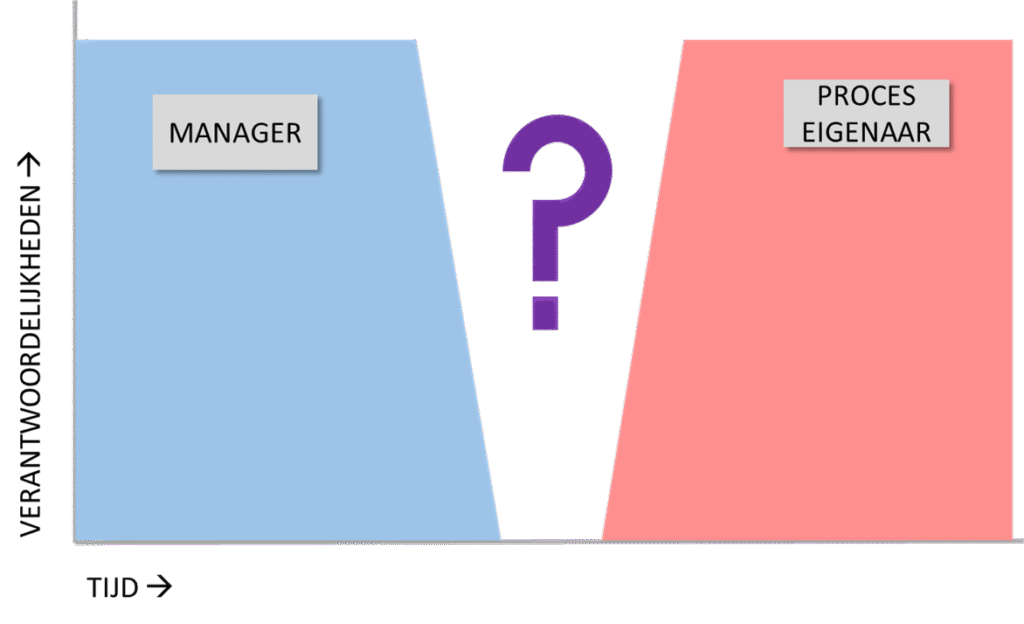
There is a risk that the “cheese slicer” approach is applied too hastily. A management layer is removed, while the rest of the organisation is still unclear about where the various responsibilities will lie. Or worse, it may never have been clear what tasks and responsibilities the eliminated manager actually had.
This creates a vacuum of responsibilities, characterised by significant uncertainty about who is responsible for what. As a result, everyone interferes in everything, and effective decision-making fails to materialise. There is no longer any focus, reflection, or improvement. The hope is that appointing a process owner will restore “calm in the organisation”.
Scenario 2: The dilemma
With the implementation of process-based working, as mentioned, a need arises for a new form of governance. At the same time, the ‘old’ form of governance formally remains in place. If the departmental manager retains their responsibilities while the new process owner also takes on responsibilities for the process, friction emerges. Interests and priorities differ, and it becomes unclear who has the final say.
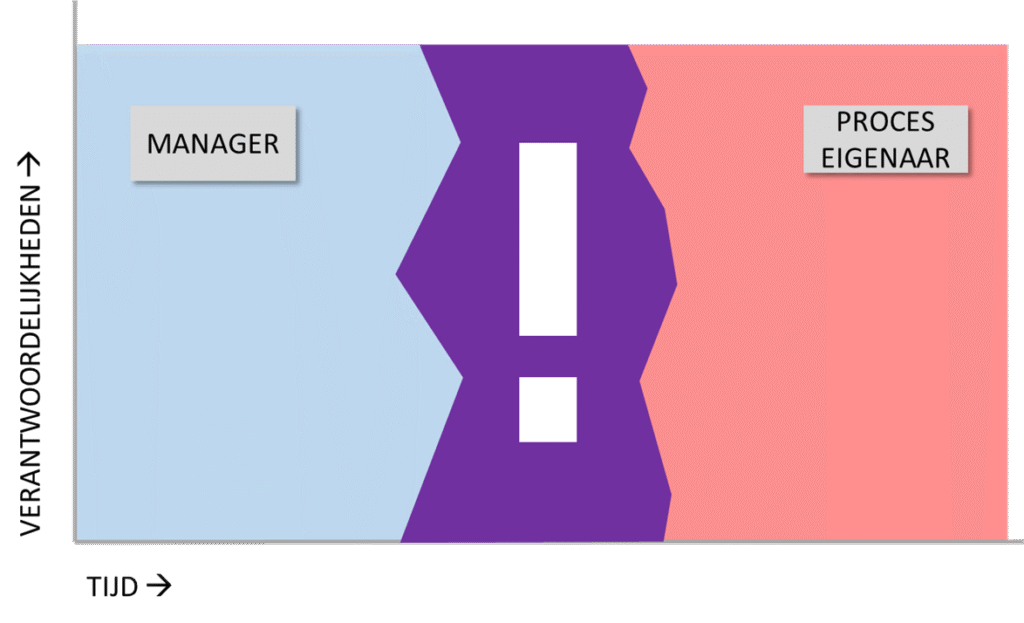
The process owner is searching for their role in managing and improving the process across departmental boundaries. Despite their best efforts to implement improvements, they encounter resistance from the departmental manager, who continues to coordinate the teams’ activities. This raises the question: who do employees listen to, and who decides what takes priority?
If the departmental manager retains their responsibilities while the new process owner also takes on responsibilities for the process, friction arises.
A power struggle develops between the two. The departmental manager is still held accountable for results, while the process owner feels responsible for how those results are achieved. It may also happen that the role of process owner is assigned to one of the departmental managers. This can create an internal conflict for that individual: should they act in the interest of their department, or prioritise the process above all else? This is not straightforward and requires clarity about each person’s role and responsibilities.
In the worst case, a lack of clarity during the transfer of responsibilities leads to a conflict between the process owner and the line manager, resulting in confusion and frustration among those involved and bringing process improvement to a standstill. Unfortunately, this is the exact opposite of what process-based working is meant to achieve.
The lead-up to a controlled handover
From a horizontal perspective, the highest priority is to deliver products and services to the customer quickly, effectively and efficiently, in other words without waste. To achieve this, a smooth flow in the activities performed is essential. Responsibilities, and the sense of ownership that comes with them, are logically focused on ensuring that this flow operates properly.
In a ‘vertical’ organisation, responsibilities, including those related to monitoring agreements and frameworks, are assigned to the departmental manager. The shift towards a process-oriented organisation requires reassigning logically connected groups of responsibilities. To do this carefully, it is important first to distinguish between different types of responsibilities.
The transition to a process-oriented organisation requires groups of responsibilities to be reallocated.
A clear understanding of these responsibilities is essential in order to find the right balance between horizontal and vertical responsibilities during the transfer. This opens the way to a third scenario.
Scenario 3: The controlled handover
Whereas in the two worst-case scenarios the transfer of responsibilities takes place either too early or too late, this scenario focuses on transferring the right responsibilities at the right time. This step-by-step transfer must be completely clear to everyone involved.
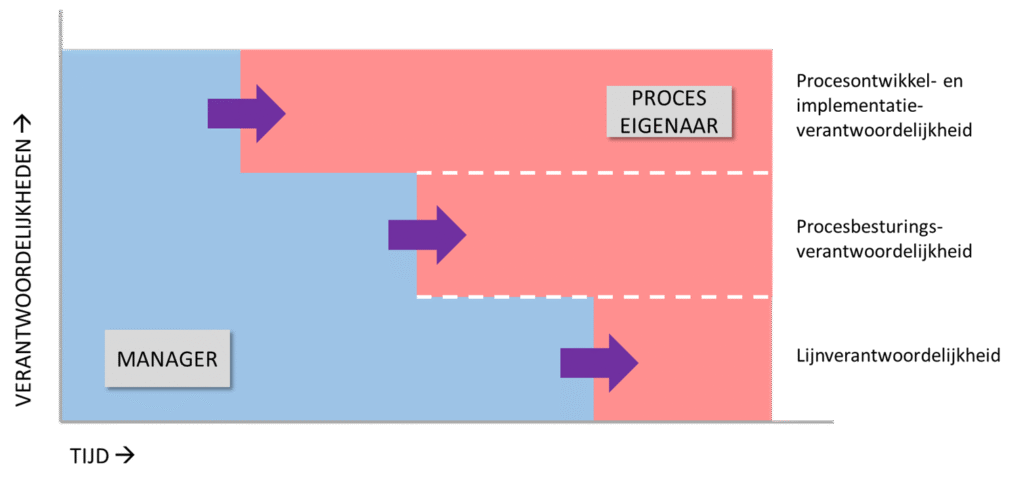
At the start of the transfer of process ownership, final responsibility still rests with the departmental manager. Once the shift to process-based working has been made, with processes identified, designed and implemented, an initial group of responsibilities can be transferred. The responsibility for developing and implementing process improvements is the most logical choice at this stage, as the manager no longer needs to focus on the entire “how” question, that is, how the work is carried out and how it can be improved.
Once these responsibilities have been successfully embedded, the next step is to transfer the governance of the process. A key condition for this is having an up-to-date dashboard with process indicators. Collaboration between the process owner and the manager is then limited to agreeing on targets and escalating problem situations.
Collaboration between the process owner and the manager is reduced to setting performance agreements and escalating issues.
As a final step, line management responsibility can also be transferred to the process owner. At that point, the organisational structure is fully aligned with processes, and it may even be possible to adjust the formal employment relationship with colleagues. This increases the organisation’s flexibility to respond quickly to change, but it also introduces new challenges. The traditional role of line management changes significantly and becomes much smaller, and consideration must be given to how coordination across processes will be organised.
Conclusion
If the organisation has decided to adopt a process-oriented approach, a clear decision must be made about who will be responsible for the processes. It is also important to recognise that past responsibilities no longer align with the organisation’s evolving governance needs. It is logical to reduce more traditional management tasks, as process-based working lowers the need for coordination and direct supervision. However, this does require clarity about who will be responsible for what, and how these responsibilities will be rolled out and embedded. A poorly considered transfer often leads to a power vacuum or, conversely, to a conflict between those responsible. It is therefore essential to ensure that responsibilities are transferred correctly and at the right time.