Consultancy
 Processen Effectief Standaardiseren
In recent years, organisations have increasingly focused on standardisation. In practice, however, this proves far from straightforward. There is often a lack of a clear approach, strong leadership and sufficient attention to change management. Nathan van der Meulen of BPM Consult shares six success factors to ensure that standardisation truly becomes a tool for moving the organisation forward.
Within organisations, standardisation is once again being embraced as preparation for software development and the implementation of new applications. It is used to gain control over complexity, costs and fragmented ways of working. At the same time, standardisation is a widely used term whose meaning is under pressure. It has, to some extent, become a buzzword in management language.
This trend is visible in both non-profit and for-profit organisations. In education, standardisation is often mentioned as a prerequisite for making education more flexible, yet execution frequently falls short of ambition. In the corporate sector, the focus is on efficiency, successful ERP implementations and improved data analytics.
The underlying promise is similar: employees move away from working in isolated Excel sheets and towards uniform applications, the central organisation gains greater control, and processes become cheaper, faster and less prone to errors.
The problem
In practice, executing standardisation projects proves to be complex. Despite investments, the intended objectives are often not achieved. Ambitions fall short before they translate into concrete changes, or projects become bogged down due to an overly broad scope. It also happens that initiatives result in extensive documentation, without clarity on how the organisation is meant to apply it.
In addition, standards are frequently abandoned under pressure. As soon as a location or department shows resistance, an exception is made. IT is then adapted to support this local variation, leading to additional costs and increasing complexity. There is often a prevailing sentiment of ‘but we are genuinely different from others’.
The underlying causes
These situations are not isolated incidents, but symptoms of structural shortcomings. Standardisation projects fail due to the absence of a clear approach, a lack of leadership and mandate, and limited attention to change management.
Standardising requires a disciplined approach in which choices are made explicitly and consistently upheld. Without a clear methodology, standardisation becomes bogged down in discussions, repetition and disconnected documentation.
In many cases, there is also a lack of visible leadership from management and a clear vision for the change. Standardisation affects existing interests and routines. Without active sponsorship and clear direction, the initiative remains non-committal. Closely linked to this is the frequent lack of clarity about who has the mandate to define the standard and who is authorised to allow deviations.
The result is that standardisation becomes a costly operation that fails to achieve its original objectives. Energy drains away from the employees involved, confidence in the project declines, and software development comes under pressure. Organisations then revert to custom solutions to support different process variants, leading to higher costs.
Six succes factors
Standardisation can be approached differently. Effective standardisation is characterised by (1) a clearly defined objective from the outset, (2) a process-oriented approach, (3) explicit decision-making, (4) the structured mapping of variations, (5) change management as an integral part of the approach, and (6) an organisation that understands and applies the standard.
1. Define the end goal in advance
A standardisation project without a clearly defined end goal tends to continue indefinitely. Moreover, standardisation cannot be an objective in itself. It is therefore essential to determine at the start when the project is complete and what the concrete outcome will be. Decide which processes will be standardised and which may be addressed in a second phase.
An end goal might be the delivery of a process design that has been formally established within the IT system. Alternatively, it could be the approval of documentation alongside the introduction of a local change agenda. Making clear choices upfront prevents uncertainty and repeated reprioritisation during the project.
2. Take the process as the starting point
There are various ways to approach standardisation for IT design, such as by department, location, theme or process. In this perspective, a process-oriented approach is central. A process describes how work is actually carried out across departments. By taking the process as the starting point, you work directly within the core of the organisation.
A process design makes it visible how the organisation functions and where handovers and dependencies exist. Because processes are multidisciplinary, standardisation provides an opportunity to break down departmental silos and create a shared understanding of the desired way of working.
3. Organise decision-making
Standardisation requires explicit decision-making. It must be clear in advance who determines the standard and which deviations are no longer permitted. This requires a decision-making body with a clear mandate.
During the preparation phase, this group establishes three elements. Design principles are defined based on the strategy. Agreements are made on how to deal with variation and which formats will be used to substantiate decisions. Exceptions may be accepted, for example when required by local laws and regulations.
Finally, mental models are made explicit, such as biases, historical choices or previous experiences. Openness about these increases the quality of the subsequent process.
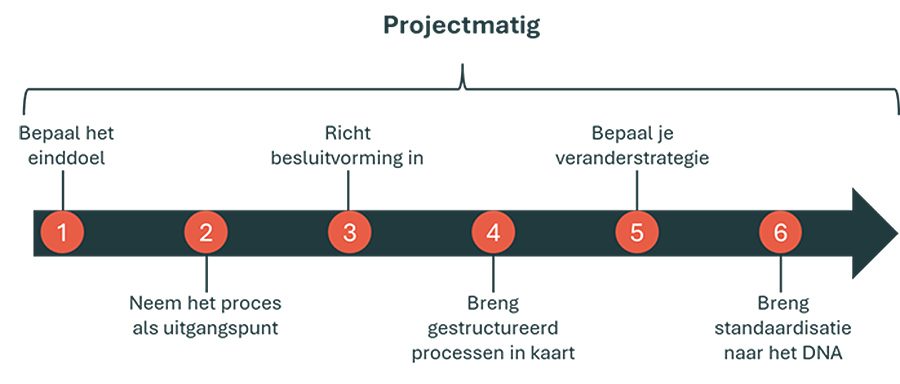
4. Structured process mapping
After the preparation phase comes the substantive phase. The aim is to make variations visible and assess them. This can be organised in five steps.
First, the current process of one location or department is mapped out based on existing documentation, forming the reference point. Second, variations at other locations are identified through workshops and, where possible, supported by analytics and process mining. An overview is then created of all variations.
Based on this, decision-making is prepared. The decision-making body establishes the best practice and determines which variations are no longer permitted, taking local laws and regulations into account. To support content-related decisions, the ESSA model can be used: eliminate, simplify, standardise and automate. Finally, the standardised process is modelled and documented.
The outcome is an agreed process as input for IT, alongside an overview of variations that indicates which local departments or locations need to change.
5. Define your change strategy
Standardisation directly affects the day-to-day operations of departments and locations. A well-considered change approach is therefore essential. In addition to explaining the why and outlining the vision for the future, it is important to answer the question for each stakeholder: what is in it for me?
This may include learning from other locations, having a more robust process, or improved data quality at head office. During implementation, established best practices must be communicated widely. Unapproved deviations should lead to a targeted local change agenda, while approved deviations are explicitly recorded and shared.
Attention to the time investment and involvement required from affected departments is essential. Compensation and targeted incentives can support acceptance and accelerate the move towards the standard.
6. Embed standardisation in the organisation’s DNA
An important effect of standardisation is that employees are actively involved in developing the standard and gain insight into their own processes. By connecting disciplines and locations and involving local experts in analysis and decision-making, mutual understanding is created.
After the project is completed, a structural governance model must be in place. Deviations that arise over time are assessed against the standard. This can be managed by local experts in close coordination with process experts at head office, or through process governance supported by dashboards and process mining.
Under project pressure, the temptation to allow local variations in IT is strong. Effective standardisation, however, requires consistency and determination. The organisation must move towards the standard. This calls for a lasting structure that continues to function even after the project has been completed.
Conclusion
By establishing these six success factors, standardisation becomes a tool to move the organisation forward. The result is a set of standardised processes with best practices, a solid foundation for IT implementation, a focused change agenda for local departments, and a sustainable governance structure after the project is completed, with strong buy-in across the organisation.