Consultancy
 Van Brandjes Blussen Naar Procesregie De Evolutie Van De Moderne Ict Manager 7
From firefighting to preventive working
Who doesn’t recognise it… An acute problem arises in operations. Everyone pulls out all the stops, and every possible resource is brought in. An emergency meeting is scheduled, and a plan is put together at lightning speed to limit the damage. In the end, it is over. We have narrowly avoided disaster, but the problem has been resolved. ‘Luckily, we pulled it off again!’ And once more, we have experienced what a fantastic team we are!
The art of firefighting
It is a true art for an organisation to be able to firefight effectively and thereby resolve acute problems in operational processes. It requires sharp analysis, decisiveness, and tight coordination. It also calls for the ability to execute tasks quickly and flawlessly, and for seamless collaboration. It is an art that not every organisation possesses.
The downside
Being able to resolve acute operational problems effectively also has a downside. After all, a significant number of issues must have occurred for an organisation to develop the routine needed to deal with them successfully. The crucial question is how well the organisation performs in ‘fire prevention’. This is learned, among other things, by reflecting on past mistakes. It is no coincidence that, after a fire, an in-depth investigation is carried out into its cause. This is done to learn from the incident and to prevent similar situations in the future. It leads to the tightening of preventive policies, thereby avoiding much hardship down the line.
A business without acute operational issues does not exist, but a large proportion of problems can be prevented. The process canvas can be used as a tool and a roadmap to tackle acute problems successfully. Even more important than resolving the issue itself is learning from both the problem and the chosen solution.
Start with the problem
The route starts in the process canvas at the bottleneck in the current way of working. The problem. This might involve, for example, high levels of absenteeism among nurses in a respiratory ward, fines due to late deliveries to customers, or a sudden decline in student satisfaction at a university of applied sciences.
Start by mapping out the problem. What exactly is going wrong, and where are the pain points in the operation? Also determine where the problem occurs and which processes it affects. Then look for the root causes. What is driving the issue? After all, you cannot solve a problem if you do not understand what is causing it.
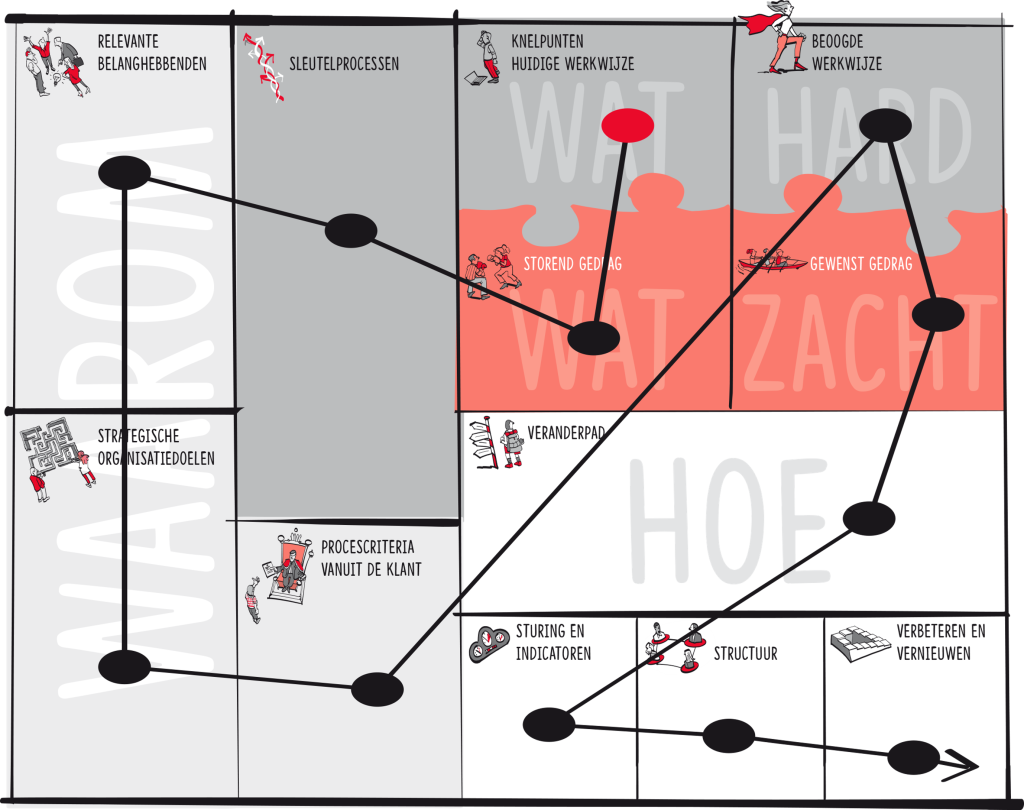
Next, clarify why this is a problem for the organisation. Which stakeholders are affected, and in what way? Map out the (potential) impact on organisational objectives. For example, late deliveries may lead to failing to meet the delivery reliability target. Then explain the consequences of this. This ensures that everyone involved is convinced of the importance of resolving the issue.
Design the solution
Is the problem clearly defined? Then determine the requirements the new way of working must meet. What are the process criteria from the customer’s perspective? For example, what is the maximum delivery time? Or which student expectations must be met to achieve the desired level of student satisfaction? Translate the customer’s needs into measurable criteria that the process must fulfil.
Now roll up your sleeves and get to the drawing board. Design the new way of working. What needs to change in the process to meet the defined process criteria? Work this out in detail, for example in a process design, the blueprint of the new process. Also consider what behaviour is required from employees and determine what changes in behaviour are needed.
It is never finished
At the point on the horizon, it is only just beginning. You know what you want, but you are still a long way from achieving it. Bring together all efforts to truly turn the tide. Work out all the actions and map out the “change journey”, from informing and training employees to acquiring the necessary resources. Ready to go? Get started and put the new way of working into practice.
Measure how you perform against the defined criteria. Set up the structures needed to sustain the way of working or to improve it further. And before you begin, decide when you will evaluate the process, because that evaluation will mark the start of the next improvement cycle. It is never finished.
Get started
Resist the temptation to take large steps in an attempt to solve things quickly. The fire may be extinguished, but there will be no structural improvement. The route through the process canvas shows how to tackle operational problems effectively. It does not produce short-term fixes; instead, it marks the beginning of a journey of continuous improvement.