Consultancy
 Van Brandjes Blussen Naar Procesregie De Evolutie Van De Moderne Ict Manager 8
How can you, as a childcare organisation, turn internal auditing into an excellent tool for continuous quality improvement, resulting in cross-fertilisation between staff, a clear vision of quality, and concrete improvement actions? Here are the five success factors and a step-by-step approach to creating inspiring internal audits.
The inspiring audit empowers pedagogical staff and strengthens the team’s capacity to improve. It does so by encouraging open discussions about the quality of care and by identifying where a location excels as well as where improvement is needed. Based on this, staff identify improvements during the audit that they consider desirable or necessary. This increases employees’ sense of ownership of quality improvement, as well as their enthusiasm and engagement.
There are five success factors for the ‘inspiring audit’. Apply these and turn the internal audit back into a powerful instrument for quality improvement.
1. Engage in open dialogue
An open conversation about the quality of childcare is at the heart of an internal audit. Staff themselves know best what can be improved; the challenge is to make optimal use of this knowledge. This often does not succeed when auditing is based on a standard questionnaire. It can quickly feel like an interrogation, prompting the auditee to conceal shortcomings while the auditor struggles to uncover improvement opportunities. It is far more interesting and enjoyable to engage staff in a conversation about how they deliver high-quality childcare. Discuss where the team excels and what the challenges are. This builds trust and allows you to jointly determine the areas in which the team wants or needs to develop.
Tip 1: Use a visual overview of quality as the basis for discussion
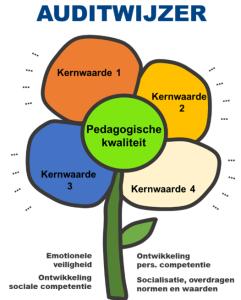
Forte Childcare has had good experience with this approach. They developed the ‘Audit Guide’ or ‘Working Guide’, which provides a visual representation of the key aspects of quality. At Forte Childcare, the quality of a location is determined by the extent to which pedagogical quality and Forte’s core values are realised. In the ‘Working Guide’, this has been further elaborated by defining pedagogical quality through the four basic goals of Riksen-Walraven and translating each of Forte’s core values into four sub-aspects. The auditor uses this ‘Working Guide’ when visiting a location to discuss the quality of care and identify areas for improvement. Teams can also use it for self-evaluation and quality improvement.
2. Provide a balanced view
Traditional audits mainly assess the areas in which a location does not comply with organisational policy or legislation. That is certainly important, but it does not provide a balanced view of the location. In an audit, do not focus solely on what goes wrong, but also examine where a location excels. By also making strengths a topic of discussion, a broader picture of quality emerges. This provides insight into how a location’s strengths can be further developed and increases the added value of internal audits.
Tip 2: Also highlight in the audit report the areas in which a location excels and compile an overview of these. This encourages teams to discuss these strengths and learn from one another.
3. Be action-oriented
“You know, we should really do that more often” or “if only we had this, then…”. The auditor notes it in the report. But why not seize this opportunity to agree on a concrete action together during the audit? Let staff themselves specify what could be done differently and, if appropriate, who will do it and by when. It would not be the first time an employee says, “I’ll sort it out straight away.”
The principle of an action-oriented audit is that for every point of attention or shortcoming identified during the audit, a concrete action is defined. Small actions can be addressed immediately, while larger ones can be developed further at the next team meeting. In this way, you set the improvement engine in motion during the audit itself. This prevents the audit from resulting in a list of observations that never lead to action.
Tip 3: Follow up the audit after four weeks to review the progress of the improvement actions, just as in a traditional audit. This reminder gives an extra boost to the “improvement engine” or provides an opportunity to celebrate success.
4. Have audits carried out by process managers
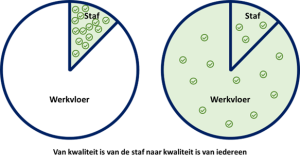
Give pedagogical staff the role of internal auditor instead of assigning this solely to support departments. After all, it is the staff who are responsible for delivering quality in practice. By giving them the role of auditor, they are challenged to form a sharper view of what constitutes ‘good’ childcare and why certain working agreements are truly important.
During the audit, auditors engage teams in a discussion about how they work and why. This leads to cross-fertilisation between staff. This is further strengthened when auditors share experiences with each other and decide which themes should receive extra attention in future audits.
By positioning staff as auditors, you stimulate the development of a shared vision on quality. Auditors bring this vision and expertise back to their own teams. As a result, quality increasingly becomes something owned by the teams themselves rather than solely by support departments and management. This also aligns with the shift towards self-organising teams.
Tip 4: Organise a basic training course for each auditor, in which they become familiar with the ‘Working Guide’ mentioned in Tip 1 and learn how to conduct an open dialogue and translate this into concrete actions.
5. Organise the audit cycle
OnDesign an annual cycle for conducting audits, as is done with traditional audits. Start with an annual kick-off, during which you determine the focus of the upcoming audits together with the auditors and discuss the audit schedule. This is followed by the audit period.
Equally important is to organise a mid-term evaluation to share experiences and tips, and to jointly refine the focus, planning and audit guide. At the end of the cycle, it is time for a comprehensive evaluation of both content and process.
- Evaluation of content, for example, looks at questions such as: “What are the most significant or most common strengths and points for improvement?” and “Which topics deserve more or less attention?” To prepare for this evaluation, produce a report summarising the main findings of all completed audits.
- Evaluation of the process focuses on questions such as “How did the audit cycle run?” and “How did I fulfil my role as an auditor?” When pedagogical staff act as auditors, it is especially important to jointly determine what is needed to improve the quality of the audits. This might include additional training for auditors or expanding the audit team.
Tip 5: Assign someone the role of ‘super auditor’. This person is responsible for overseeing all steps of the audit cycle and preparing the various meetings.
Geef uw feedback over BizChat
Get started
In other words, how can you turn the internal audit into a tool for continuous quality improvement, one that genuinely inspires improvements in quality?
- Evaluate the current approach and determine to what extent the five success factors are present.
- Decide what the new audit cycle will look like.
- Design your own ‘Guide’ based on Riksen-Walraven’s pedagogical goals and the organisation’s core values, together with the auditors.
- Create a new format for the audit report, including space under each element of the audit guide for areas for attention and examples of excellence, as well as space for agreed actions.
- Set up an audit team, including practitioners, and train the auditors in the new approach.
Forte Childcare has already led the way
BAt the beginning of 2018, Forte Childcare (Forte) decided to thoroughly renew its auditing approach. A working group consisting of auditors and those responsible for pedagogical policy and the quality management system, supported by BPM Consult, set out to find a new way of auditing. The guiding principle in shaping this new approach was ‘growing together’. For Forte, this meant:
- No longer conducting audits based on a questionnaire, but instead using a visual that represents the various aspects of quality. This was renamed the ‘Audit Guide’ and greatly supports conducting a genuine dialogue with staff.
- During the audit, not only identifying points for improvement, but also highlighting strengths. It is precisely from the strengths of others that you can learn and grow as an organisation.
- Recording not only observations, but also concrete actions. In this way, improvement can immediately be set in motion across the entire team.
What Forte Childcare was already doing, and continues to do because of its positive experience, is having audits carried out by practitioners. This leads to cross-fertilisation between teams and locations. In five steps, Forte has thus turned the internal audit back into a valuable tool for continuous quality improvement.