Consultancy
 Evolutie Van Procesarchitectuur Zijn Uw Processen Bij De Tijd Een Spiegel En Appel Voor Modernisering
Organisations engage in process management, whether consciously or not. After all, they ensure that what needs to be produced actually gets produced. In that sense, processes are synonymous with sequences of activities that must be aligned, like runners in a relay race. Those organisations that consciously work on process management often carry a considerable legacy with them. Too few organisations have brought their processes into line with the era in which we live. That is a missed opportunity, as the promise of excellent process management is significant. Take a look in the mirror and determine which era your process architecture belongs to.
What exactly was process management again?
“Management of processes” is highlighted in management models such as INK or EFQM as a key aspect of governing organisations. Control is necessary because the aim is always to deliver the right value to those who have a stake in it. By stakeholders we mean the board or financiers, customers or clients, employees, and the environment or society in which the organisation operates.
Effective value creation is therefore central, both the objective and the outcome of sound process management. Process management means that work processes are identified and designed, directed and controlled, analysed and improved, and innovated and renewed, so that value creation can consistently meet the expectations of stakeholders.
Shifting panels
No one is opposed to process management, but how do you actually put it into practice? What should you focus on, and who should take responsibility for it? Over roughly the past 25 years, many different perspectives have been developed to answer this question. These perspectives have shaped how process management is implemented in organisations.
If you ask, “How do you manage your production processes here?”, you will certainly get answers. However, the content of those answers varies considerably. In nine out of ten cases, the form of process management reflects the period in which its foundations were laid, but it also indicates the organisation’s ability to adapt.
Often, there is a founding figure of process management, sometimes still active, who once had the insight and, like a hen guarding her eggs, holds firmly to the principles established at that time. At the other extreme, there may be three different schools within the organisation, all working on process management but unable to form a unified approach.
Perhaps it is time for a wake-up call. Take a look at the period in which your process management originated, the questions it was meant to answer at the time, and compare those with the current challenges facing your processes. Determine whether you are carrying unnecessary legacy and whether simplification is possible. And pay close attention to the focal point: are the elements that truly matter today clearly in view? It is time to bring your process architecture up to date.
The value of process architecture
Before we take the time journey, a quick refresher: why process architecture in the first place? Because identifying work processes is the foundation for managing them. Compare it to your home. Whether you are building new or renovating, you need a solid blueprint. With a plan on the table, you gain an overview of the playing field, locate the elements, focus and position analyses, compare the current and desired situations, and explain to change agents what the improved situation should look like. The same applies to work processes: it starts with identification and analysis. Which process? What exactly do we produce? How does the process flow? Who does what? What does the customer do? What information do we exchange? Which applications support the flow?
To gain insight into the current situation and to explain the optimal way of working, process models are created. Much like analysing a flowing river by placing two markers, one upstream and one downstream, and using a snapshot to examine what happens in between. This helps you to better steer and control processes, analyse them, improve them, innovate and renew them.
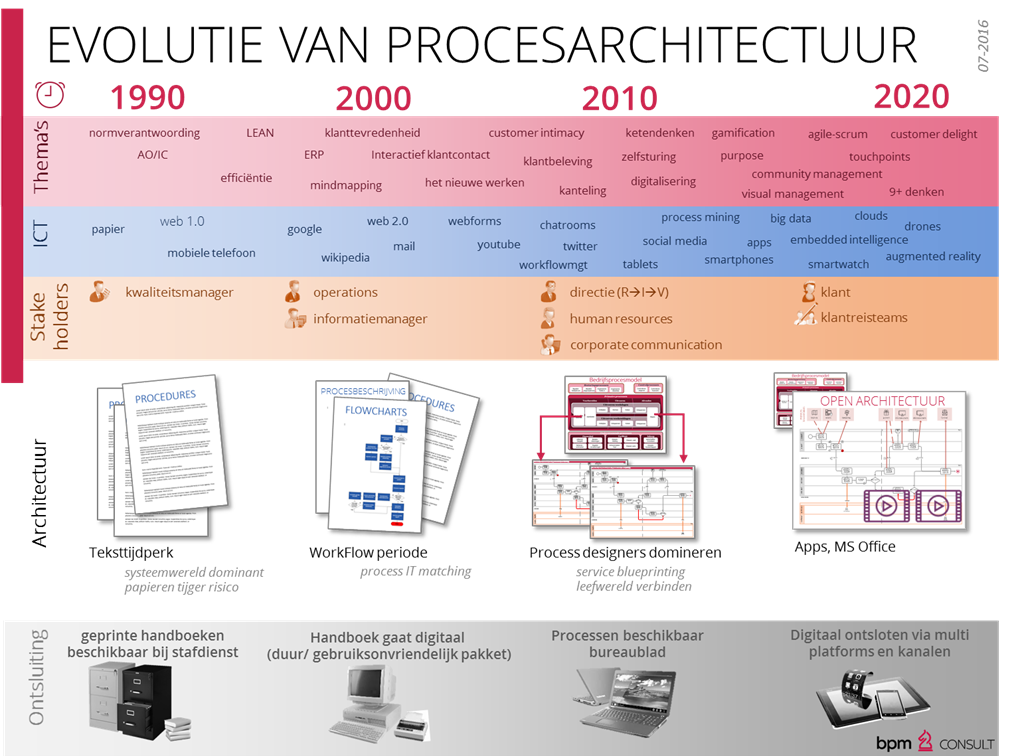
The era in which process management has been shaped leaves its mark on the elements that are brought into view. Broadly speaking, in process architecture we see a shift from internal to external, from closed to open, from text to visual, from functional to experience-oriented, and from external justification to intrinsic strength.
| From | To |
| Internal | External |
| Closed | Open |
| Text | Visual |
| Functional | Experience-based |
| External accountability | Intrinsic strength |
Let us take a step back and look at the timeline. One could make a case for starting in the era when scripts were created for the funerals of pharaohs in ancient Egypt, but for the sake of simplicity we will begin our classification in the 1990s.
The procedural era
In the early 1990s, process architecture largely equated to writing procedures. The quality discipline was dominant, and external recognition of quality was a requirement to remain competitive. The focus shifted from product quality to process quality, and quality standards required the documentation of production processes. This was carried out on a large scale, often coordinated by quality managers, as they were responsible for obtaining and maintaining certification.
The word processor was the primary tool, the printer a key means of communication, and manuals provided transparency. Procedures were strictly formatted, with fixed headings such as purpose, scope, and performance indicators. Structure and order were shaped by the chapters of external standards frameworks. Customers were involved as satisfied end users of the final products. Their satisfaction was discussed, and good service was demonstrated through documented complaint handling.
Can you place the quality manual on the table, with a table of contents closely aligned to a standards framework? If so, there is a strong chance that this era still dominates.
The workflow era
By the time we reach the year 2000, the landscape looks very different. The phenomenon of Enterprise Resource Planning (ERP) makes a strong entrance. As automation capabilities and needs increase, there is a growing desire to integrate information components into process design. Companies do not want to automate inefficient processes, so they start to design smarter ones. Thought leaders such as Michael Hammer (Reengineering the Corporation; Faster, Cheaper, Better) are widely read.
The focus shifts to logical steps, identifying bottlenecks in workflows, and automating low value-added activities. A partnership emerges between information managers, quality managers and operations management. Where this alignment fails, multiple parallel process worlds tend to arise. Workflows begin to support processes, while flowcharting techniques are enhanced or replaced. Processes and procedures become digitally accessible in multiple locations. Digital applications that allow process information to be analysed and cross-referenced in various ways are increasingly favoured. Manual-based structures evolve into hierarchical process models, organised in pyramid-shaped layers.
And the customer? They benefit indirectly through faster delivery, shorter lead times and improved reliability.
Are your organisational processes stored in a digital document management system? Presented as flowcharts in a top-down, five-column structure? Modelled and stored in a tool provided by your ERP vendor, with visual links to databases and applications? These are clear indicators of this era.
The service architecture
Around the first decade of the 21st century, business operations start to look quite different. The financial and economic crisis confronts organisations with a pressing need to analyse and improve their processes. Lean gains strong momentum and various Belts, such as Orange and Black, emerge, trained in identifying waste. Processes are scrutinised and approached as value streams, mapped horizontally. All activities are included. In group workshops, activities are classified as value-adding or non-value-adding. Improvements are carefully defined and appear on management agendas as quick wins or major projects. Agile sprint formats are introduced to achieve substantial improvements.
There is also another driver for process redesign, at least as powerful. By now, Web 2.0 is well established and offers many new possibilities for digital interaction with customers. Information and communication technology rapidly enters operational processes, and the marketing discipline becomes heavily involved in these processes. Multi-channel strategies are defined and translated into operational execution. New service concepts emerge and customer communication is completely transformed. This is also reflected in organisational structures, with the emergence of front offices and back offices, and collaboration lines being redesigned and streamlined.
The artificial distinction between the lived world and the system world is also diminishing rapidly. Senior management begins to see processes as the operationalisation of strategy and aligns direction, design and execution. All business disciplines are represented in the process architecture and integrated organisational architectures begin to take shape, often referred to as enterprise architecture. Service blueprinting becomes a dominant process design technique. Advanced process design tools support this movement.
The customer becomes much more involved. They play an active role in organisational processes, can engage with the organisation through multiple channels, schedule their own interactions, and access status information. This also becomes a cost-saving strategy, as customers take over certain process activities by providing and retrieving information themselves, such as data and photos.
Are your organisational processes primarily styled as service blueprints? Are customer activities part of the process model, and are the touchpoints clearly visible? Are the lines of interaction clearly defined? And is the division of roles between front office, back office and support central within the processes? These are indicators of this era.
De modular architecture
Kijken we vandaag om ons heen, dan zien we dat de (r)evolutie zich door zet. W(Information and communication) technology continuously creates new possibilities and at the same time calls for integration into processes. Sensors, robots, radar systems and virtual reality devices make new things possible while also requiring organisations to respond. The organisations that succeed are those that excel by managing innovation and renewal as a core process.
Proactive analysis and improvement of processes is also changing in nature. Project-based structures such as Lean departments are being phased out, and improvement is shifting from project-based work to a permanent and continuous effort. Process teams are evolving into customer journey teams, which introduce ongoing quick wins in work processes through practical sprint cycles.
Horizontal organising is taking shape and the operational level is literally coming to the forefront. The world of experience and the system world are now fully connected. People who shape the work process together also improve their interactions together, both with each other and with the customer. This is supported by social horizontalisation, where departmental barriers no longer act as cultural obstacles. Coaching leadership helps customer journey teams to perform strong analyses and supports them in advancing improvement initiatives.
And then there is the voice of the customer. It is no longer represented by static results from customer satisfaction surveys, such as a score of 7.3 based on telephone research of past interactions. Instead, organisations make a difference through customer delight, enhancing the customer journey by creating wow factors. These are the unexpected extras that customers receive, creating a genuine positive emotional response and strengthening loyalty. Customer journey maps are now widely used, based on likes, dislikes and emoticons, similar to those in social media. Visual elements within process architecture continue to expand.
This places new demands on the tools used by improvement teams. The analytical framework and the work process must integrate both the customer journey and the internal production process. Process design should present both sides of the coin. A ‘service blueprint plus’, which also includes the physical elements that customers encounter during their journey, is one such design approach. All customer interactions, including physical aspects, are incorporated into the work processes.
The implementation of changes also takes on a new form. In the era of YouTube, smartphones and apps, traditional textual documentation within process architecture is minimised. Work instructions remain important for doing the job correctly, but they appear in formats such as e-learning modules, screen recordings and videos. Operators can record instructions using helmet cameras, share them via apps, and colleagues can review them later at home on tablets.
Access to processes is also becoming easier. Standard desktop software often proves more user-friendly than complex design tools and avoids licensing restrictions. Self-managing improvement teams can quickly adapt process designs and share updates with colleagues. Process designs are built flexibly, using a small set of practical building blocks. Organisations select useful elements from BPMN and maintain the link with IT systems. Standard office applications are used to visualise processes, link them easily and make them accessible through custom-designed landing pages.
Is this just a vision of the future? Excellent process management anticipates the era we live in. Process architecture tells the truth. Do you recognise your organisation’s processes in these descriptions? If so, congratulations: your process architecture is up to date.
Tips and next steps
If this resonates, here are some practical suggestions:
- Look at the creation dates of your processes and procedures. Does the revision history start ten years ago, around 2006 or later? Ask yourself whether your work processes have evolved sufficiently with developments over the past decade.
- Open a process on your screen and ask yourself, “Where is the customer?” You can score up to 10 points: 2 points if the customer is a clearly visible participant in the process, 2 points if the touchpoints between customer and organisation are immediately visible, 2 points if the communication channels for customer interaction are shown, 2 points if the physical elements encountered by the customer are included in the process, and 2 points if there is a clear category of improvements focused on customer delight.
- Map out a customer journey. Ask a customer to describe their journey, from the first point of contact with your organisation to the delivery of the service. At five stages in the journey, ask them about their experience and represent it visually using emoticons. Then compare this with your process design. Do they match? If not, consider how the process design can be adjusted to align better.
- Take a sample of five randomly selected employees. Ask them to show you the latest work instructions for order processing. If it takes them more than ten seconds to find them, your process architecture is not accessible enough.
- Are your work processes stored in a software tool that requires licences? Compare the number of licences with the total number of employees. How widely are they accessible? If the answer is insufficient, experiment with designing and sharing processes through standard office tools. For example, a business process model in PowerPoint, process designs in Visio, with simple hyperlinks connecting them.
Renco J.M. Bakker is the founder of BPM Consult, a consultancy that helps organisations improve their process management. He is the author of several books on process management, including Management of Processes and Horizontal Organising.
Willem Spronk is a BPM consultant. He supports organisations in analysing their processes, developing process architectures and implementing continuous improvement. He is one of the authors of the Process Management Models book.